
 Last updated 21 August 2026
 10 sets of terms read
What counts as a dormant account, and the rules that apply
A dormant account is one you have stopped using, and each casino sets its own definition for the period of time after which they start charging a monthly fee to hold money that they aren’t providing a service for.
This is not a free hand. The Gambling Commission publishes these boundaries in the player focused area of their website, and the rules are very specific and detailed.
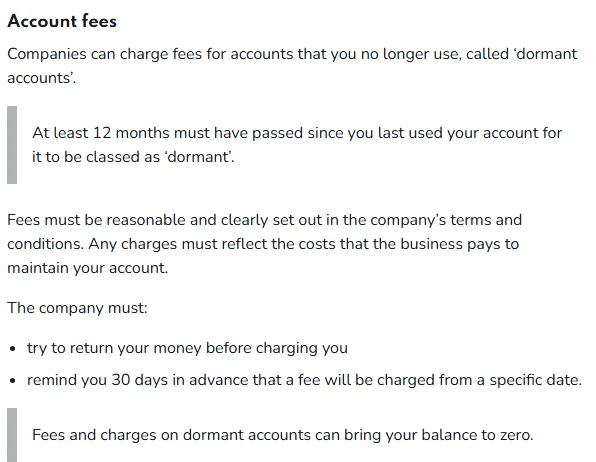
Five of these criteria are outlined in that brief section, and all of them are questions you can direct to the operator.
- Twelve months, minimum. At least 12 months must have passed since you last used your account for it to be classed as dormant. Nobody may start the meter sooner.
- Reasonable, and written down. Fees must be reasonable and clearly set out in the company's terms and conditions.
- Tied to what it costs them. Any charges must reflect the costs that the business pays to maintain your account. That is the test the size of a fee has to meet.
- They must try to pay you first. The company must try to return your money before charging you.
- Thirty days' warning, with a date. They must remind you 30 days in advance that a fee will be charged from a specific date.
 Twelve months, minimum. At least 12 months must have passed since you last used your account for it to be classed as dormant. Nobody may start the meter sooner.
 Reasonable, and written down. Fees must be reasonable and clearly set out in the company's terms and conditions.
 Tied to what it costs them. Any charges must reflect the costs that the business pays to maintain your account. That is the test the size of a fee has to meet.
 They must try to pay you first. The company must try to return your money before charging you.
In total, if you put the twelve months and the thirty days together, then the earliest they are legally allowed to apply a charge is around thirteen months after you last used the account. That is precisely the case with the operators on this page, which means that they work off the same rulebook.
The Commission also states the consequence in one short and clear sentence, and it is worth quoting this, as most operators prefer not to be straightforward about it, ‘fees and charges on dormant accounts can bring your balance to zero.’
What the ten casinos charge on a dormant account
Each figure is from the operators' versatile terms and conditions, and every casino name links to the review where the remaining parts of the document are analysed. This list is in ascending order.
| Casino | Dormant after | Monthly fee | What resets the clock |
|---|---|---|---|
| All British Casino | 12 months | £10 from the 13th month | Access or a transaction |
| PlayOJO | 12 months | £5 | Logging in |
| Betway | 12 months | £5 | Logging in |
| BetVictor | 396 days | £5, accrued and taken later | Deposit, withdrawal or wager only |
| William Hill | 13 months | £3, on the 28th of the month | A login with activity |
| bet365 | 365 days | £2 every 28 days | Logging in |
| Grosvenor Casinos | 12 months | None, stated outright | Logging in |
| Midnite | No clause in its terms | None found | Not applicable |
| MrQ | No dormant state at all | None, stated outright | Not applicable |
| Betfred | Not published | Not located | Not published |
The last, least read column is the one to focus on here. Seven of the ten publish an expiry clock, and six of those reset the clock on login. BetVictor's 396 days of clock inactivity without a deposit, withdrawal or bet means signing in to check a balance there resets the meter industry wide.
Two of the terms are structured in a way that makes them unique. BetVictor's £5 is added on a monthly basis, and all twelve charges are taken together once the account has been inactive for 12 continuous months, so naturally logging back into the account does not result in any funds being taken. Betway has a two-stage structure. The fee is charged after 12 months, and after 18 months the account is closed and the funds are returned on request to customer support.
All British Casino's £10 is the steepest charge of the bunch, and their terms explain the charge. The fee is charged on the 13th month of account inactivity, and the account is closed when the balance is zero.
Why the licence rulebook says nothing about dormant accounts
The Licence Conditions and Codes of Practice is the document under which every British operator is licensed. It consists of 133 different conditions, which address everything from money laundering to how a machine should display its licensed status.
"Dormant" is nowhere to be found. Nor is an inactivity fee, time limit, or what happens to money left behind. The term “inactive” appears for the first and only time in the financial risk assessment pilot to define a group of test customers.
Therefore, the twelve month floor and the thirty day warning are neither licence conditions nor the outcome of licence conditions. They originate in consumer law, and reach the licence via a single provision of the Social Responsibility Code (7.1.1). This provision states that the terms of the offer of gambling must not be unfair, as defined by the Consumer Rights Act 2015, must be transparent as defined by the same Act, and must not constitute an unfair commercial practice as defined by the Digital Markets, Competition and Consumers Act 2024.
Why that is relevant for you. Section 62 of the Consumer Rights Act defines an unfair term as one which, contrary to the requirement of good faith, causes a significant imbalance in the parties' rights and obligations to the detriment of the consumer. An unfair term is not enforceable against a consumer. This is the test that a dormancy clause must satisfy, and it is irrelevant to the Gambling Commission.
There is more to the Act to determine if the test applies. Section 64 shields terms that define the price of what you bought from being considered for fairness, so no one can argue in court that a stake was expensive. However, that protection is only useful if the term is both visible and prominent. The Act states that a term is considered prominent if it is brought to the attention of the consumer in a manner that a reasonable consumer would notice, an average consumer being one who is reasonably well informed, observant, and circumspect.
A monthly fee buried in clause 15 of a terms document is quite distant from that description. Schedule 2 of the Act contains what lawyers refer to as the grey list which section 63 defines as an illustrative and non-exhaustive list of terms that may be considered unfair, and item 10 of that list contains a term that irrevocably binds a consumer to terms of which the consumer had no real chance of knowing, and of which the consumer had no real chance of becoming aware of, prior to signing the contract.
This does not impose any specific illegal fee. No legal case has been found regarding a dormancy charge relating to gambling. What this demonstrates is why "clearly set out in the terms" appears in the Commission's guidance as a requisite.
The competition case that set the dormant account floor
The rules above have a short history. On October 21, 2016, the Competition and Markets Authority started an investigation into online gambling after the Gambling Commission raised concerns about potential breaches of consumer law.
Dormancy was one of the named strands from the beginning. The CMA’s own case page outlines its concerns as “dormancy terms that allow firms to confiscate funds or impose apparently excessive charges after a certain period of inactivity”. It describes finding firms that charge dormancy and firms that remove all funds from inactive accounts.
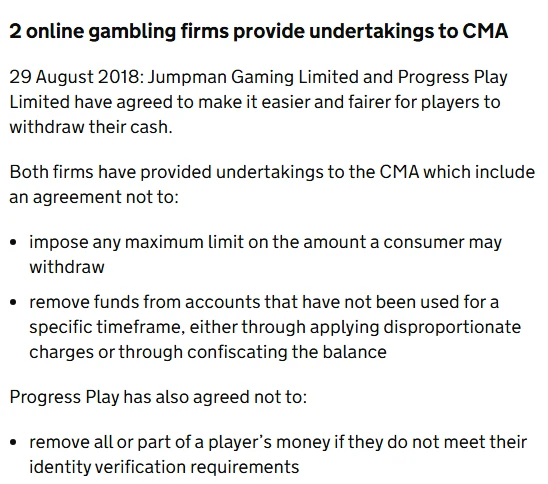
On August 29, 2018, two firms, Jumpman Gaming Limited and Progress Play Limited, both promised the CMA not to set any maximum limit for withdrawals, and not to remove funds from accounts that have not been used for a certain period of time by imposing excessive charges or by removing the balance. Both firms run a large number of white labeled casino brands. Therefore, the undertakings offered affected many more sites than just the two firms involved. The joint CMA and Commission programme finished with a joint letter on April 29, 2019.
Here’s the legacy clearly shown in the table. Six careless operators levy dormancy fees, and all six of them have converged on the same model: twelve months (and sometimes longer) before stopping the clock, and then thirty days’ notice prior to collection. Five of the six also state that they will try and return the balance to the last payment method, and bet365 makes further steps and requests a verifiable account in the name of the person in question, which is a small part of the wider verification system. Six competitors do not converge on the same model by chance.
What a dormant account fee actually costs you
Each charging operator on this list uses a flat monthly amount, so the math is easy, and the values come out more spread out than you would expect. Take the same forgotten £40 and place it at all of them.
- Four months at All British Casino. £10 a month clears £40 in four charges, and the account closes when the balance reaches zero.
- Eight months at PlayOJO or Betway. £5 a month. At Betway the account is also closed at eighteen months, with the balance returned on request.
- About thirteen months at William Hill. £3 on the 28th of each month.
- Roughly eighteen months at bet365. £2, charged every 28 days, which works out at thirteen charges a year.
 Four months at All British Casino. £10 a month clears £40 in four charges, and the account closes when the balance reaches zero.
Therefore, the same £40 survives four months at one casino and a year and a half at another. Neither operator is doing anything unique. The disparity is that no one has limited the maximum amount of the charge; only the earliest date it can go into effect.
The Commission counters the operators' flexibility with vocabulary. Charges “must reflect the costs that the business pays to maintain your account.” There is no published information about what those costs are, at any operator, so a customer cannot corroborate a £10 charge against a £2 charge and determine which is closer to the truth. The weakest point of an otherwise clear set of rules, is the lack of clarity on what those costs may be.
The specifics worth noting. Bet365 gives customers 35 days’ notice (versus the rules dictating 30 days), and William Hill takes its fee on a fixed calendar date. If you are trying to catch a balance before it begins to deplete, the warning email is the concern you have to watch out for, because the period differs by operator and the email must name the date.
The casinos with no dormant account fee at all
Three of the ten charge nothing and the fourth apparently charges nothing. Evidence for the three that apparently charge nothing is rather subjective. The promise to never charge and documentation that never mentions charging are two distinct promises.
- MrQ, the strongest wording anywhere on this site. Its terms say that if you have not logged in or contacted them for an extended period, it does not apply any inactive or dormancy fees, your account will remain active, and any balance on your account will remain on the account. There is no dormant state to fall into.
- Grosvenor Casinos, an explicit promise. Accounts still go dormant after twelve months without a login, but the terms state that no funds will be deducted while an account is classified as dormant, nor are your rights as a consumer affected by a dormant status. It also confirms dormant balances keep the same level of protection as active ones.
- Midnite, silence. No dormancy or inactivity charge appears anywhere in its terms of service. That is a real advantage and it is checkable, but silence is not a commitment, and terms can be amended.
- Betfred, unknown. No dormancy clause could be found on any public Betfred page. Its terms are scattered across separate policy pages and the main document renders in the browser, so the clause may exist somewhere I could not reach. Absence of a published clause is not confirmation that there is no fee.
How to check any casino in a minute. Open the general terms (or conditions), not the promotions page, and search the document for “dormant” and then “inactive.” Almost every operator uses one of those two terms as a heading for the clause. If neither is present, search for “administration fee.” If nothing is returned, you are in the Midnite situation: no payment is likely, and there is no written evidence of that.
Self-exclusion is the one exit the rules actively protect
What surprised me the most while reading through the licence conditions was this. There’s technically no rule that says you can’t leave a casino account silently. The only rule is self-exclusion, which you do under licence conditions.
Licensees must comply with Social Responsibility Code 3.5.3 by closing customer accounts and refunding the self-excluded customer’s funds. Additionally, it’s not enough for licensees to bar self-excluded customers from withdrawing funds and continuing to take bets.
So, if you are stopping to self-exclude because you developed a gambling problem, then the operator is obligated to return your funds. However, stopping to self-exclude because you’re bored means nobody is obligated to do anything, and there may be a monthly fee after thirteen months.
One point that is relevant, as people do confuse the two. If you sign up to Gamstop, you’re completely locked out of all the companies under Gamstop, and the scheme states that signing up to Gamstop does not automatically return any withdrawable funds. Each of the companies you have an account with must be contacted personally, and the details are on the Gamstop page.
A time out or a deposit limit would not activate any of the above. Those are caps and pauses. The account is active, and it is your account, so the dormancy clock is still active. The dormancy clock is a separate item under the safer gambling tools.
The wallets kept the fees the casinos gave up
The six month floor rule applies only to gambling licences. Payment companies sit outside it. Between you and most casinos are electronic money firms, and there is nothing in the Commission’s guide to address such companies. Things are different.
| Where the money sits | Charging starts | Monthly fee | Trigger |
|---|---|---|---|
| paysafecard code | The 2nd month | £3 | Taken from the credit left on the voucher |
| Skrill wallet | 6 months | €5 | No login or transaction in six months |
| Neteller wallet | 6 months | US$5 | No login or transaction in six months |
| paysafecard account | The 13th month | £5 | No transaction in the previous twelve months |
| A UK casino account | 12 months at the earliest | £3 to £10 | The floor the Commission sets for licensees |
A paysafecard voucher has a value that starts to erode after one month. A casino account is protected from being accessed for a minimum of twelve months. The protection for that same money is lost when it is moved a step back along the chain and only eleven months elapse.
Both Skrill and Neteller have a six month time limit, the shortest of any such account on the page, and both are part of the Paysafe group that issues paysafecard. All three of these payment methods are found in the lower section of our payment methods comparison regarding protection and the detail for each of these methods can be found on the Skrill and Neteller pages as well as on the paysafecard page.
There is no scheme to reclaim a forgotten casino balance
If you leave your money in a bank account, it will remain there indefinitely. The Dormant Assets Act 2022 has created a reclaim fund addressing this very issue. This Act extends a previous scheme covering bank and building society accounts to long term insurance assets, pension assets, investment assets, client money assets, and securities assets. In the meantime, the right to claim back the money remains.
There is not a single mention of gambling or betting in that Act. The money balance in a gambling account is outside of the scheme, and, once dormancy fees have been charged to reduce the account to zero, there is no fund that can be claimed.
What protects it. A dormant balance is customer funds like any other. Licence condition 4.1.1 defines customer funds to include winnings or prizes that the customer has chosen to leave on deposit with the licensee, so a forgotten balance sits in the same segregated client account as an active one, at whatever level of protection that operator publishes. This level varies a great deal, and is provided on our funds protection page.
Stopping a dormant account fee before it starts
Five minutes beats a complaint in a year’s time. If you have an account somewhere you have not used since last summer, work down this list.
Find the clause. Open the general terms and search for "dormant", then "inactive". It is usually a numbered clause with its own heading, and it will name both the period and the fee.
Check what resets it. Almost every operator restarts the clock when you log in. BetVictor counts money moving instead, so at that one a visit alone may not be enough.
Take the balance out if you are finished. Minimum withdrawal amounts can strand small change, which is how a lot of these balances end up dormant in the first place. PlayOJO sets no minimum at all, and MrQ will release a sub £10 balance in full if you email support.
Watch for the thirdty day email. It must notify you that there will be a corresponding charge from a particular date. That is your only notification and your only evidence.
If you truly want to leave the account closed, it cannot be closed until balance is at zero. If you have to leave because of self inflicted financial harm, do the self-exclusion since it is the better option for you as it guarantees a refund of your deposit.
If you feel a charge was made in error, the operator must hear you out. There are steps you can point to in the Commission’s reports that state the attempt to return the money prior to charging, the thirty day warning, and the date the fee will commence. If you reach the eight week limit without resolution, it goes to the operator's dispute resolution service, and the route for each of the ten is explained on our complaints page.
Frequently asked questions
A minimum of twelve months. The Gambling Commission’s player guide states that at least 12 months must have passed since you actively used your account in order for your account to be considered dormant. This gives the company the right to charge you after the send-out of the reminder notification 30 days prior with the notification of the specific date the charge will commence. In practice this places the charge at roughly one month later, which is the approximate time that operators on this page take to charge.
Fees can drain it. The Commission states that fees and charges on dormant accounts can bring your balance to zero. A firm cannot just take the balance. When the Competition and Markets Authority took undertakings in 2018, they agreed to not remove funds from unused accounts, either through the application of disproportionate charges or by taking the balance.
It almost always happens. bet365, Betway, Grosvenor, and PlayOJO reset the timer when you log in, and William Hill and All British count a log in when there is interactivity with the account. BetVictor is the exception on this list, as it runs a timer an entire 396 days without a deposit, withdrawal, or wager, so a log in that moves no money may not count there. It is best to check what kind of timer your casino uses to make sure you don’t think you are safe on a log in.
MrQ states in its terms that no inactive or dormancy fees will be charged and that your account will remain active. Grosvenor states that 12 months of account inactivity results in dormancy, but no funds will be removed in that time. Midnite has no such statement in its terms. There are no public statements on Betfred confirming a dormancy policy, though it could be inferred from the lack thereof that no such policy exists.
I can ask, but this must be first put through the operator, as a complaint must go before the operator before anyone else will take a look at it. The Commission’s rules provide you with something you can point to: the 30 day warning citing a specific date and the attempt to return your money prior to charging. After a period of 8 weeks or reaching an impasse, the operator’s dispute resolution provider will take it from there.
Rules on this page were read from the Gambling Commission, the Competition and Markets Authority and legislation.gov.uk on 20 August 2026 and link to their sources. Dormancy terms come from each operator's own terms and conditions and are set out further on the linked review. Operators amend their terms, so the casino's own document is the one that counts. Corrections to callum@megareelslot.com.
18+. Gambling can be addictive, please play responsibly. Free support: BeGambleAware.org or the National Gambling Helpline on 0808 8020 133.