
 Last updated 21 August 2026
 Rules quoted from source
The question nobody asks until it is too late
When a gambling business goes bust, the money patrons have on account is a case of insolvency law and a decision has already been made on the matter when the operator selected language in their terms. This decision was likely made before the operator even opened their doors.
Every operator that is licensed to hold client funds is obligated to disclose which arrangement they have selected. Most people don’t even read this since the language is aimed at being soothing and the disclosure themselves are buried. The phrase “your funds are held in segregated accounts” would lead you to believe they're protected. This is not the case.
Here are the four categories along with what they actually provide if the operator goes under and the phrase to search for in order for you to confirm any casino in under 30 seconds.
The four rating categories
Usually, consumer protection grading systems have three levels. The option picked by operators has four since “not protected” can split into two.
| Category | What it means | Protection in insolvency |
|---|---|---|
| Not protected, no segregation | Land-based and ancillary remote operators only. An online casino cannot use it. | None |
| Not protected, segregated | The minimum for every remote operator holding customer funds. Money sits in accounts separate from business accounts, but it would form part of the assets of the business in an insolvency. | None |
| Medium protection | Quistclose accounts, insurance arrangements or equivalent. Separate accounts plus arrangements to distribute those assets to customers in an insolvency, with no absolute guarantee. | Partial |
| High protection | A formal trust account, legally and in practice separate from the company, verified by and subject to controls by an independent trustee or external auditor. | Strongest |
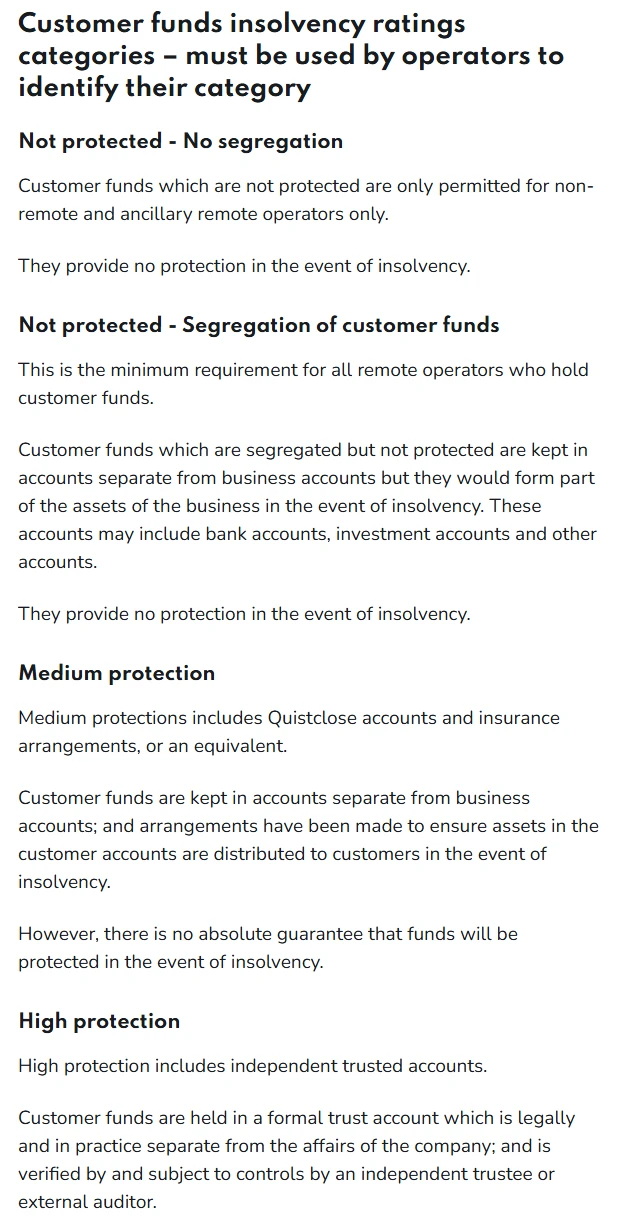
In the top category, the Commission does not set boundaries and instead enumerates the factors: a formal trust deed that names the trustees and describes their duties; a legal and operational separation of the trust from the company; and either an independent trustee or regular external audits.
Segregated is not the same as protected
This sentence is the reason you should read this. In the category required of all online operators that hold customer funds, is the Commission's category “not protected, segregation of customer funds.”
In its own words, this means customer funds are kept in accounts separate from business accounts. However, should the business fail, these funds would be considered business assets. And then, in four words, "they provide no protection in the event of insolvency."
As such, a casino can say in full truthfulness that your funds are held in segregated accounts and still rank at the bottom. Segregation is an accounting practice; protection is a legal practice.

If the terms of a casino mention segregation and stop, that is the end of the story. The categories that exceed the minimum have names, and an operator that is entitled to use one of the categories would state that, as the entire basis of the rating system is that the level is stated. The failure to state the level is the statement itself.
How to find your casino's rating in thirty seconds
Statements that operators can adapt are available through the Commission. As a result, there is a high level of consistency in the language used across all operators, a feature that is beneficial for you.
Click through and view the Casino’s terms and conditions. These can sometimes be a hyperlink in the footer, however, many operators place it in an article in their Help Centre.
Search for “at the level”. The required text is something along the lines of “this meets the Gambling Commission’s requirement for the segregation of customer funds at the level: medium protection”. Many operators have stated it as “at the medium level of protection”. Therefore, “level” is the correct phrase to use for your search.
If that search does not yield any result, search for “insolvency”. The requirement means that this disclosure must be included somewhere in theTerms, and therefore this is the word that is relevant to your search.
Check if the Commission has been linked in the disclosure. Operators need to link to the ratings page in order to disclose, hence if there is no rating stated, but this page is linked, it should raise some concern.
Remember, there are requirements in each licence that operators must adhere to. However, operators need to take care not to imply that the Commission has approved their rating level, as this is not the case. The operator assesses its own arrangements against a published standard and states the result.
What the rule actually requires
This statement is made as an obligation under licence condition 4.2.1, and this is deemed to be more important than the ‘small print’.
Licensees that hold customer funds must inform the customers about the level of protection afforded to the customer funds in case of insolvency and how such protection may be achieved. This information must be provided to the customer in writing in a manner that requires the customer to confirm receipt and that prohibits the customer from using the funds to gamble until the customer confirms receipt. When you deposit funds for the first time and when you deposit funds for the first time after the operator amends its terms regarding this matter, you must receive such information.
In simpler terms, that box that you clicked through on your first deposit was this rule. You have been informed already.

As a reminder every six months. An operator that has selected a “not protected” rating must remind you that customer funds are not protected in case of insolvency. Before you are allowed to use the funds, you must confirm receipt of the reminder. If you receive a message that states the amount of customer funds that are not protected, this is not a system error. This is the licence in action. This reminder is most appropriate for money that is held in an account that is not active (i.e. the account on this page that is describing dormant accounts). A balance that is dormant is still customer funds and is protected at the same level as an active balance.
Judging whether the disclosure is any good
The Commission provides a sample of a compliant disclosure statement. A statement should:
- Explain what happens to funds in the event of insolvency.
- State a ratings category matching the arrangements actually in place.
- Give details of the type of account used to achieve that category.
- Include a working link to the Commission's customer funds page.
- Provide a way for you to acknowledge receipt at your first deposit, and again after any change to the arrangements.
 Explain what happens to funds in the event of insolvency.
The errors the Commission identifies in statements are also published. This list helps you appreciate what you're looking at.
The common errors the Commission finds
Five fails are so common that the Commission publishes them for operators.
- The link to the ratings page is missing from the statement, or it is broken.
- There is not enough information about the account used to segregate or protect the funds.
- The statement never specifically says what happens to funds in insolvency.
- Terminology is misleading, "for example using the term 'protect' when only segregation is in place".
- Acknowledgement is assumed from a general continue button, in place of a separate tick box or button on the deposit page.
The fourth one on this page is a statement written by the regulator, calling an arrangement ‘protect’ where the only consideration is segregation. It is a known compliance fail the Commission tells operators to stop making.
What counts as your funds, and what does not
The definition of customer funds is the aggregate value of the funds held to the credit of the customers, and the list is more inclusive than just cash in hand.
- Cleared deposits you have paid in to stake on future gambling.
- Winnings or prizes you chose to leave on deposit, or that the operator has yet to account to you for.
- Crystallised but unpaid bonuses, which means a bonus you have already earned in cash terms and not yet been paid.
- Money staked in an open bet is not customer funds. The Commission states it plainly: money staked within open bets is not covered by any arrangements the business has in place to protect customer funds if it becomes insolvent.
 Money staked in an open bet is not customer funds. The Commission states it plainly: money staked within open bets is not covered by any arrangements the business has in place to protect customer funds if it becomes insolvent.
That one is worth a minute. An unresolved bet is one where you have paid the consideration and the relevant event has not yet occurred. If a bookmaker fails over the weekend with your accumulator still pending, that stake falls outside the protection arrangement regardless of the company's rating. For a casino player, the exposure is less, as the outcome of a slot or a card game is immediate. However, anything in a pending tournament or an incomplete live game should also be considered.
No FSCS, and why an overseas bank account is fine
There are two assumptions that can broadly be considered reasonable. One is wrong and one is without consequence.
The incorrect one first. There is no Financial Services Compensation Scheme protection on gambling balances. The FSCS protects money placed with authorised banks, building societies, and credit unions. An account at a casino cannot be considered a deposit account. The funds that customers assume are protected and amount to £85,000 in an account, do not apply here at any level.
The irrelevant one: gambling operators are legally permitted to place funds at a bank located outside the UK, and the Commission states that this should not affect your rights because money in your account is dealt with based on the protection in place. Since most of the companies licensing British casino brands are registered in Gibraltar, Malta or Cyprus (as the licence table shows), this occurs often and is a non-issue.
What the ten casinos here disclose
Here is where each of the ten stands. Two were quoted directly from the operator’s terms and conditions during the construction of this page. Five come from the research conducted for the review. Three are marked not confirmed, and this is done purposely.
| Casino | Rating | Where it comes from |
|---|---|---|
| William Hill | Medium | Read in its UK terms, 20 August 2026 |
| Grosvenor Casinos | Medium | Read in its terms, 20 August 2026 |
| Betway | High | Recorded during our review research |
| BetVictor | High | Recorded during our review research |
| Betfred | Medium | Recorded during our review research |
| MrQ | Medium | Recorded during our review research |
| bet365 | Medium | Named in its Great Britain terms, citing the Commission's segregation requirements |
| PlayOJO | Not confirmed | No named rating read yet |
| Midnite | Not confirmed | No named rating read yet |
| All British Casino | Not confirmed | No named rating read yet |
The four blanks are an honest gap. We will publish a rating only after we have read the operator’s text that cites a specific level and have thus far not done this for the three operators. A description of segregated accounts is not a rating, and it is this kind of misinterpretation that this page is attempting to explain. The blanks will be filled after confirmation, and the date at the top of the page will be changed after each confirmation.
As things stand, medium is the preferred answer for most confirmed cases, with high being the exception. There is no requirement within the licence for an operator to reach the top category, so a casino that is at medium is within the rules.
What to actually do about it
The most reasonable answer for most people would not be to change casinos for a rating, but to stop considering a gambling account as an account where money stays.
- Take your winnings out. Every pound you withdraw is a pound the rating no longer applies to. This is the whole answer, and it costs nothing.
- Read the rating before a large deposit. The exposure that matters is the size of the balance, and a small float carries a small risk whatever the site.
- Do not read the rating as a quality score. It describes one specific event, insolvency. It says nothing about whether the operator pays out promptly, verifies fairly or handles a complaint well, which is what our scoring looks at.
- Take the six-monthly reminder seriously if you get one. It only exists for the lowest rating, and it will tell you the exact sum at stake.
And the previous question, always: the context I elaborated on is applicable where the operator holds a Gambling Commission licence. A site without a licence is under no obligation to disclose a rating or provide a way to complain, which is covered in the licence check page.
Frequently asked questions
No, and this is by far the most misunderstood word in the subject. The Gambling Commission’s lowest rating for online services is “not protected, segregation of customer funds,” which means that money is held in accounts that are separate from the business accounts and would remain as part of the business assets in the event of liquidation. Segregation is the bookkeeping. Protection is a legal arrangement that is superimposed over bookkeeping.
Within the T&Cs. Licence Condition 4.2.1 states that an operator must state this, and the text almost always consists of the phrase “segregation of customer funds at the level,” thereby making searching within the T&Cs for “at the level” a quick way to find it. An operator must also hyperlink to the Commission’s rating page.
No. The Financial Services Compensation Scheme protects deposits made with authorised banks, building societies, and credit unions. A gambling account is not a deposit account. Therefore, the money held in an operator's account has no FSCS cover, no matter what protection rating an operator may claim.
No. The Commission states that money that is staked on an open bet is not viewed as customer funds, thus falling outside the arrangements the operator may have put in place in case of an insolvency event. An open bet is completely outside the protection rating.
Yes. The operator is responsible. The Commission states the categories of persons and requires the operator to compare its arrangements and state the outcome, and says to the operators to take care to ensure that they do not suggest that the Commission has approved the rating. The rating is a self-assessment against a published standard.
Rules and definitions on this page were read from the Gambling Commission on 20 August 2026 and each links to its source. Ratings for individual casinos are marked with where they came from, and unconfirmed ones are left blank on purpose. Corrections to callum@megareelslot.com.
18+. Gambling can be addictive, please play responsibly. Free support: BeGambleAware.org or the National Gambling Helpline on 0808 8020 133.