
 Last updated 21 August 2026
 All 10 adjudicators listed
The route, step by step
Formally complaining about a licensed British casino is a structured process that takes no time and no legal representation. The reasons it is not completed are most often related to the complainant not knowing where they are in the process.
Lodge a complaint in writing with the operator using their published complaints process. All licensed casinos are obliged to have a published complaints process and most have a dedicated email address or complaint form. Keep a copy of your submission.
Address the internal complaint stages. Some operators have multiple subsidiaries. An example is William Hill who have a Second Opinion service after the first response. BetVictor have three stages and if any are skipped, the case is bounced back.
Wait for up to eight weeks. The Gambling Commission is clear: operators have eight weeks to respond to complaints. If this is not done then the Commissioners are required to communicate the result of the complaint to you and communicate what will happen next.
A deadlock letter can be requested in the case of an impasse. Should an operator be unable to provide any additional information, operators should include the details for their ADR provider, and, in some instances, include a confirmatory letter that you may progress the matter to the next stage. In this instance, that letter removes the requirement for you to follow the remaining process which takes the next 8 weeks.
The ADR provider, which the operator has contracted and which is free for you to use, evaluates both sides and has the option to proceed with a decision.
You are advised to allow a period of 3 months for the decision, which also equates to the time that the ADR provider requires once it has all the information from the operator.
If the operator simply stops replying
The eventual outcome of ‘no decision’ is the most common and is actually less concerning than many people consider. The 8 week period is considered to have commenced when the complaint was received by the business and therefore an operator ignoring your request is considered to be working against their own time limit and at the conclusion of the 8 weeks you will have the right to proceed.
The adjudicators are mindful of this process. IBAS has the right to refuse a complaint where the consumer has not made reasonable attempts to contact the operator to resolve the complaint, and making such attempts is the threshold that is required. A complaint can be constructed by an email request sent and no response received. The message itself may be printed, as may be the address and the date sent. In addition, any response received and automatically generated may contain a ticket number, which should also be retained.
Once, in writing, cite around week four. Reference your original complaint and the date you filed it. After that, leave it. A second chase adds nothing to the file and the calendar is doing the work.

Something to know at the beginning of this process. ADR providers resolve disputes for the outcomes of gambling transactions, which includes the management of the account and having trouble getting your money. They do not accept customer service complaints, refusing a bet or an operator not taking your business.
Who actually adjudicates your casino
Eight ADR providers for gambling are approved: ADR Group, Pegasus ADR Service, Blexr Limited, CEDR, eCOGRA, IBAS, ProMediate, and the Tattersalls Committee. Of the online casinos, two use one of them, and which one you get is decided by the operator and is stated in the terms. This happens well before you have an issue with the online casino.
| Casino | Adjudicator | What its terms say |
|---|---|---|
| bet365 | IBAS | Contact bet365 first. If it cannot settle within eight weeks either side may refer it to IBAS, and the terms make that outcome binding on both parties. |
| William Hill | IBAS | First response, then an internal Second Opinion team, then IBAS after eight weeks or an unsatisfactory answer. |
| All British Casino | eCOGRA | Rulings bind the casino for claims below £10,000. Above that the terms state the ruling is not binding. |
| PlayOJO | eCOGRA | Manager or supervisor must respond within 96 hours. The ruling is described as binding with no monetary ceiling. |
| Midnite | IBAS | Support, then an internal complaints team on a 15 working day target, then IBAS, binding on both sides. |
| Betway | IBAS and eCOGRA | Split by product: IBAS for sports, eCOGRA for casino. Either opens free after eight weeks and internal deadlock. |
| BetVictor | IBAS | Three internal steps that must be taken in order or step three bounces. An IBAS resolution binds BetVictor too. |
| Betfred | IBAS | Reciprocal wording: if you agree to be bound by the outcome, Betfred agrees to be bound by it too. |
| Grosvenor Casinos | IBAS | The only casino here publishing a freephone complaints number, 0800 083 1990, and a postal address. |
| MrQ | IBAS | Acknowledged within 24 hours, eight week commitment, and the full IBAS address, phone and email printed in the terms. |
Six of the ten use IBAS exclusively, three employees eCOGRA exclusively, and Betway is the only provider using both. The gap in service is better than it appears. Both are free for you to use, both cover gambling which is done online and both work with written submissions. IBAS can run a verbal proceeding, while the others cannot.
Distinctions that matter rely on wording by the operator, and the best example is two casinos using the same adjudicator but on differing terms. PlayOJO states that there is no monetary limit for eCOGRA rulings. All British Casino, also on eCOGRA, states that rulings bind them for claims below £10,000 while for claims above £10,000, the rulings are not binding.
What actually makes a ruling stick
This is almost everything every single guide to this gets wrong, and some are written by people that should really know better.
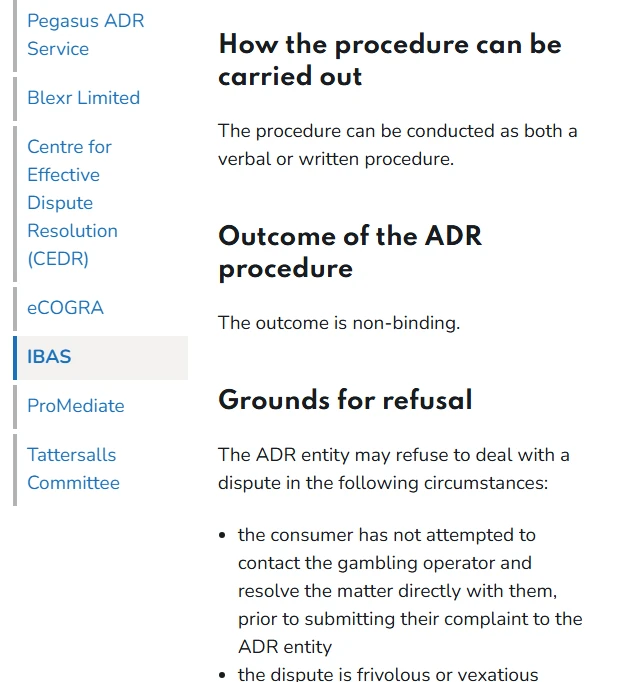
The Gambling Commission's own records for IBAS include that the outcome of the ADR Procedure is non-binding. For eCOGRA, it is the same. As adjudication schemes, neither one can force a casino to pay you.
What can bind is the contract between you and the casino. Operators agree with terms that they will abide by the outcome, which is binding in the normal sense. Betfred's terms are reciprocal: if you agree to be bound, so does Betfred. Midnite states that the resolution is binding. BetVictor states that an IBAS resolution is binding on BetVictor and you.
The question you should ask before you start is not which adjudicator the casino uses. The question should be what promise the casino has made, if there is a monetary limit on that promise, and if they have promised anything at all.
When an ADR provider will refuse the case
Both of them state (clear and fully) what grounds they have for not doing anything at all. So, before wasting 8 weeks, reading those statements is your best insurance.
| Reason | IBAS | eCOGRA |
|---|---|---|
| You have not tried the operator first | Yes, listed first among its grounds | Yes, and it wants at least two weeks to have passed since the problem began |
| The dispute is frivolous or vexatious | Yes | Yes, and also if it does not relate to the outcome of a gambling transaction |
| Another ADR provider has already looked at it | Yes | Yes, and also if a court has |
| The claim is too small or too large | Yes, against a monetary threshold IBAS sets | Not listed |
| It is too old | Yes, against a time limit that cannot be less than 12 months from the operator's notice | Yes, if the dispute arose more than one year ago |
When you check eCOGra, there is an additional factor to consider-they will refuse casino sites not found on their approved site list. If your casino mentions eCOGra in their terms and conditions, that is typically OK, and it will only take about 30 seconds to check if the operator has named their stated adjudicator.
The deadlines that close the door
There are three clocks in the gambling complaints process. One is a well-known clock.

Eight weeks, for the operator
A business has eight weeks to resolve your complaint and to inform you of the outcome.
- It runs from receipt, so the date you sent it matters. Put it in writing and keep the timestamp.
- A deadlock letter lets you move before the eight weeks are up.
- Some operators commit to faster internal targets, such as MrQ's 24 hour acknowledgement or Midnite's 15 working day internal stage.

About a year, for you
If you leave it, the adjudicator can decline it on the basis of it being too old.
- eCOGRA may refuse a dispute that arose more than one year ago.
- IBAS sets its own period, which under the rules cannot be less than 12 months from the date the operator told you it could take things no further.
- The safe reading: start within a year of the problem itself, because the clock does not wait for you to give up on the operator.

Two weeks, at eCOGRA
eCOGra sets a minimum threshold for them to consider a case.
- At least two weeks must have passed since the problem began.
- You must have followed the operator's internal complaints procedure.
- Reasonable attempts to negotiate a solution with the operator have to have been made.
What to send, and how to write it
Adjudicators work with documentation. A complaint in the form of a story will likely lose to a complaint that is in the form of a file.
- Dates, in order. When you deposited, when the problem happened, when you complained, what came back and when. A short timeline at the top does more work than three paragraphs of context.
- The operator's own words. Screenshots of chat transcripts, the email replies, and the clause of the terms you say was applied wrongly. Quote the clause number.
- Transaction records. Amounts, times and payment method, from your account history and your bank statement where it helps.
- What you want. A specific outcome and a figure. "Release the £340 withheld from my 3 July withdrawal" is a case. "Compensation for the stress" is not.
- Nothing else. Leave out how the site made you feel and how long you have been a customer. It carries no weight and it buries the parts that do.
 Dates, in order. When you deposited, when the problem happened, when you complained, what came back and when. A short timeline at the top does more work than three paragraphs of context.
If the issue stems from a broken game, the section of interest is errors and malfunctions, as our game malfunction page illustrates what casinos promise in this area. If the issue is with a bonus, the section is usually either the wagering or the maximum withdrawal terms, and where the operator states the offer was abused, our bonus abuse rules page illustrates the standard the operator should meet when explaining what happened. If the issue is with a blocked withdrawal, it is usually the verification or the source of funds terms, and our account verification page illustrates the type of request casinos are permissible to make at that point. Reading the clause may seem like a tedious step, but it’s what sets the basis of a complaint.
What the Gambling Commission does with your complaint
A large number of people think that complaint handling, by and large, is a substitute for litigation. In such cases, it isn’t.
The Commission, as a matter of fact, lacks the legal remit to resolve an individual dispute and cannot recover money for an individual. What it does do is log the event, as complaint data is used to shape how operators are regulated. In its own terminology, it encourages customers to bring forth evidence showing that a gambling business has breached its rules and terms, for use in building cases against the operators and improving the regulatory framework.
When the situation goes beyond a dispute over a purchase, report and complain. Self-exclusion that was not successful, marketing that continued to arrive, verification that was inferior, are things that the Commission can act on and has withdrawn licences for.

Reporting to the Commission does not stop the eight week period or the ADR cut off. Complain to the operator for the money, report to the regulator for the behaviour. Complaining to the regulator instead of to the operator has gotten people time barred.
After the ruling
An adjudication is not always final, and three other paths remain open depending on what went wrong.
- Ask for a review. In some cases you can ask the provider to look again. The procedure varies, and the details are on the provider's own site.
- Go to court. You can take the matter to court, and the Commission suggests independent legal advice before you do. For most gambling disputes this means the small claims track, where you can act for yourself.
- Complain about the provider itself. If the problem is the service you received, complain to the provider. If you believe it is in breach of the Digital Markets, Competition and Consumers Act 2024, that goes to the Chartered Trading Standards Institute.
One thing that the Commission makes very clear is that it cannot intervene in the decision of an ADR provider or ask the provider to review its decision. That door is closed and knowing that avoids a letter.
What changed in April 2026
The oversight of this system moved, and published guides have not yet been updated.
The Gambling Commission is still the regulator of gambling. From April 2026 it will not be the relevant regulator for the accreditation and oversight of ADR providers in the gambling industry, and the Chartered Trading Standards Institute will be the competent authority for approval of ADR providers in the gambling industry in accordance with the Digital Markets, Competition and Consumers Act 2024. The Commission has already stopped accepting applications from businesses that wish to be gambling ADR providers.
For a player with a complaint today, nothing changes for you with the route. You must still complain to the operator, must still wait up to eight weeks, must still go to the adjudicator named in the terms, and must still not have to pay anything. What changes is who accredits the adjudicator and who decides what to do about the complaints against the adjudicator.
The next change that people are interested in, which was also introduced in the 2023 White Paper, an Ombudsman for Gambling was proposed. The industry was asked to create a completely independently run Ombudsman service and with the government keeping a right to create a similar Ombudsman service through legislation if that did not happen. Following that plan, IBAS has said it intends to provide that service. Until then, using this guide, this is the route for ADR.
Frequently asked questions
Eight weeks after it receives it, according to the Gambling Commission. The business must communicate the result of the investigation and its next steps When eight weeks pass and you are not satisfied with the resolution, you may send the complaint to the operator's ADR.
This is not necessarily the case. In instances where the operator reaches deadlock before, it must give you the contact information of its ADR service and in some cases, a letter confirming you can escalate, known as a deadlock letter. In that case, you may ignore the rest of the eight weeks.
It depends on the casino, not the adjudicator. The Gambling Commission lists both IBAS and eCOGRA as producing non-binding outcomes as ADR entities. A ruling is mostly self-binding, as most casinos state that they will self-bind to the outcome, sometimes with a money limit stated, so it is worth checking that clause before playing.
During my work, this process takes about a year, however, this depends on the provider. eCOGRA will probably reject a dispute that is older than a year. IBAS has its own time period which, according to its rules, cannot be less than 12 months of the date the operator told you it would no longer accept the matter.
You can ask the provider to review its decision and as a last resort, you can go to court and for this case, I would recommend you get independent legal advice. The Gambling Commission will not step in for an ADR provider's review and it will not ask the provider to reconsider its decision. If your complaint is about the provider's service or conduct, now it goes to the Chartered Trading Standards Institute.
Rules and provider details on this page were read from the Gambling Commission on 20 August 2026 and link to their sources. The adjudicator named for each casino comes from that operator's own published terms. Corrections to callum@megareelslot.com.
18+. Gambling can be addictive, please play responsibly. Free support: BeGambleAware.org or the National Gambling Helpline on 0808 8020 133.