
 Last updated 21 August 2026
 Technical standards checked
Three things a fair UK casino game may not do
Most articles that try to answer this question only go as far as stating “licensed casinos use certified random number generators,” which is correct (albeit almost useless). The technical standards go way beyond that, and they address the three issues that actual players have.
- The game may not adapt to you. RTS 7 says that adaptive behaviour, "that is, a compensated game", is not permitted. The guidance spells out what that covers: automatic or manual interventions that change the probabilities of game outcomes occurring during play. A slot cannot tighten because you are ahead, and a person cannot reach in and change it either.
- Near misses may not be manufactured. RTS 7C prohibits game designs or features that may reasonably be expected to mislead the customer about the likelihood of particular results occurring, "including substituting losing events with near-miss losing events". If a reel stops one symbol short, that is what the draw produced.
- The free version may not be generous. RTS 6 requires play-for-free games to implement the same rules as the corresponding play-for-money games on the same website, and operators must take all reasonable steps to ensure they accurately represent the likelihood of winning and the prize distribution.
 The game may not adapt to you. RTS 7 says that adaptive behaviour, "that is, a compensated game", is not permitted. The guidance spells out what that covers: automatic or manual interventions that change the probabilities of game outcomes occurring during play. A slot cannot tighten because you are ahead, and a person cannot reach in and change it either.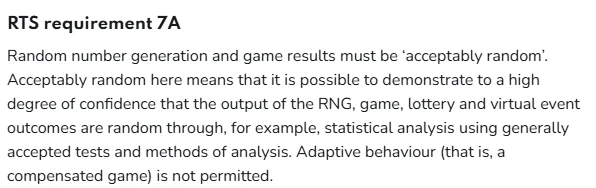
These are not hopes. Licence condition 2.3.1 dictates that licensees comply with the Commission’s technical standards, so a game that behaves this way is a licence problem to the operator providing this game.
What "acceptably random" actually means
The standard provides a testable definition of what that phrase means. Outcomes must be acceptably random, meaning it must be possible to show, with a high level of confidence, through statistical analysis using generally accepted tests, that the results are random.
This section of the guidance discusses the characteristics of a random number generator that would be considered adequate. Firstly, the output should span the entire range and should be evenly distributed. Outcomes should occur according to the likelihood associated with each case. It must exhibit unpredictability. In the case of a software generator, it should not be feasible to predict the next outcome without complete knowledge of the algorithm and the seed. It must not generate the same output stream, and two instances must not synchronize with one another. Increasing the number of outputs should not provide an opportunity to predict future outputs, and scales should be used to preserve the integrity of the output.

A statement that addresses the obvious gap in the rules. In RTS 7B, it is stated that random numbers that are generated “are to be used in the order in which they are generated and they may not be discarded due to adaptive behaviour”. Only a number that falls out of range can be discarded, and the event should be investigated and a record should be made. Random number generators are not good enough to ensure a game is not rigged. If the software is able to discard the results, then the standard states that it cannot.
Physical equipment also has its own rules. Physical equipment relies on the laws of physics to decide the outcome of a game. For such games, the materials for the mechanical devices should not decompose as the players should not be able to come into contact with the mechanism and not be able to alter the properties of the physical devices. Also, the game should not allow the ball to decompose.
The ban also does not target bonus rounds that are designed according to their own rules. The guidance clearly states that restricting adaptive behaviour is not meant to stop games from providing bonus or special features involving a different set of rules, as long as they are activated through random events.
The demo game rule, and its one honest gap
There is a whole standard dedicated to the suspicion that free play runs hot to hook you. This is referred to as RTS 6, and as the Commission states, the purpose of this standard is to lessen the likelihood that customers are misled about the likelihood of winning due to the behaviour of play-for-free games.
The free game should use the same rules, and it should appear that the same chance of winning and same kind of prizes will be offered in the free game. The guidelines mention the mechanics. The free game should use the same random number generator (RNG) as the paid game, or an RNG of similar quality. Regarding virtual cash, the payouts should match the cash game, and tokens should be allocated in relation to the stakes and prizes of the cash game.

Here is the gap, and the Commission explains it. The rule binds the free game "offered on the same facilities (that is, the same website)". The guidance then addresses demonstrations elsewhere: where a supplier's own website is showing a game with higher than normal returns, it should be made clear that it is a demonstration game specifically designed to demonstrate the bonus features. This means a demo in a licensed casino has to use real maths. A demo on a game studio's marketing site may not follow and should explain this.
The same guidance applies to promotional videos, which state that where footage has been edited or sped up for promotional purposes this should be made clear to consumers. If you have ever watched a slot trailer where the bonus lands every few seconds, that is the rule it is meant to be following.
This operator sidesteps the issue entirely. British Casino states on its own about page that it completely lacks a demo mode and requires a login in order to load any game, which is rare for a British site.
What a casino must publish before you play
RTS 3 states that applicable rules must be accessible prior to a commitment to gamble, and that these rules must also be accurate and adequate. It then requests something of more benefit.
Information pertaining to your chances of winning must also be accessible prior to a commitment, including a description of how the game is played and how winners are determined, as well as one of the following three options: house edge or margin, the return to player percentage, or the probability of winning events occurring.
Read that list again as the word between the measures is ‘or’. An operator satisfies the requirement by publishing any of these measures. RTP is the measure that the industry settled upon for slots, and is the measure you will generally find disclosed in an information panel. A slot game disclosing house edge is also in full compliance with the standard. The standard requests that the rules of bonus rounds must also be provided, as well as the number of tokens/symbols required to activate the bonus, and that the state must constantly be shown as the game is being played. For instance, the number of tokens/symbols you have collected.
Who actually checks that the games are fair
Testing is done by neither the Commission nor by the casino. Rather, it is performed by test houses that the Commission has authorised, and the Commission posts the list.
Fourteen test houses are on the list. All of the designated test houses are approved to perform remote technical standards tests. They all are required to have full accreditation to ISO 17025 and also selected aspects of both ISO 17065 and ISO 27002. Any new product must be tested by an approved test house before it is released and a test report must be forwarded to the Commission.
- The list is shorter than it looks. Six of the fourteen entries are Gaming Laboratories International companies and two more are BMM, so eight of the fourteen sit inside two groups. The others include eCOGRA, Gaming Associates Europe, Global Lab, Quinel, RiskCherry and Nick Farley & Associates.
- There is an annual audit as well as pre-release testing. Licensees holding the relevant licences must submit an annual games testing audit carried out by an approved test house. It checks a random sample of updates, confirms change controls were followed, confirms the list of games actually offered, and confirms effective live RTP monitoring is in place.
- Somebody has to sign it. The audit results must be counter-signed by the relevant personal management licence holder or specified person before submission, which puts a named individual behind the report.
 There is an annual audit as well as pre-release testing. Licensees holding the relevant licences must submit an annual games testing audit carried out by an approved test house. It checks a random sample of updates, confirms change controls were followed, confirms the list of games actually offered, and confirms effective live RTP monitoring is in place.
Monitoring games after they have gone live
A game may pass all of its required tests, yet fail in the field, and the Commission has a separate solution to this problem. Licensees are required to ensure effective monitoring of RTP is implemented, “for both under and overpayments”. The best known method is to calculate the actual RTP based on real play and compare it to the stated RTP.
The strategy does not set any guidelines on how often to perform the monitoring. It states that performing the monitoring once a month is insufficient for popular games with rapid, high volumes of play. It states that performing the measurements each day over the last 30 days of play would be an acceptable method, as the figure would be constantly calculated and evaluated over a variable volume of play. This measurement should be automated, and alerts should be generated when measurements fall outside the acceptable range. Each game’s volatility should be used to set the range.
This shows how much effort was put into this. It is good to have checks for “must not be so aggregated that it hides errors at a lower level”, and the example is a mistake that only exists in the mobile version of a game, which could get lost in a calculation that consolidates all markets and channels. Someone has clearly seen that.
This is where we also see the best operator fairness disclosures. BetVictor posts eCOGRA audits of all bets made on its casino and defines the real return to player for all bets, published monthly with the previous quarter’s audit certificates. Betfred discloses that its suppliers perform continuous real-time monitoring and that a game that is out of line is removed until the investigation is complete. PlayOJO discloses real-time monitoring and automated reporting and defines a per-game payout rate in the game lobby.
The answer you are owed if you complain
This is the fairness question that no one writes about, and it is the most useful thing on this page.
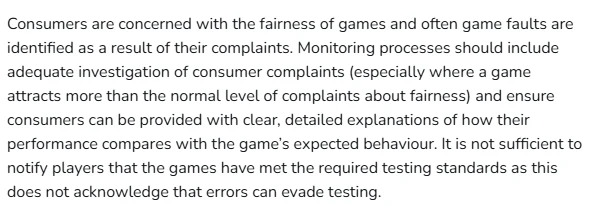
The Commission acknowledges that players are in need of reassurance on the fairness of the games and that it is typically player complaints that identify existing faults. It then tells operators what a good response should look like: adequate investigation of a reasonable level of complaints is important, and should allow consumers to be provided with an explanation of their performance in the context of how the game behaved as expected.
The important sentence is here: "It is not enough to notify players that the games have satisfied the mandatory testing requirements, as this fails to consider how some errors can avoid testing."
So if you make a complaint about fairness and the answer you get is about certification, then that is not what the regulator said was adequate. What you are entitled to request is how your play matches what the game was anticipated to perform. The complaint procedure, in the absence of this, is on our complaints page, and the Commission also collects intelligence about operators, even if they will not resolve your complaint.
What the ten casinos publish about fairness
The same rules apply to all ten. The main difference is how much each of them is willing to show you. The range you are looking at here is the widest for anything you will find on this website.
| Casino | Testing it names | What it publishes about actual returns |
|---|---|---|
| BetVictor | eCOGRA | Realised RTP for all bets, audited quarterly, with the last three months' certificates published |
| PlayOJO | eCOGRA and iTech Labs | Real-time automated monitoring, and a payout rate published per game in the lobby |
| Betfred | An external test house, unnamed | Suppliers run continuous live monitoring; a game out of line is pulled while it is investigated |
| William Hill | External RNG certification | Theoretical RTP in every game's information panel, plus a per-player result log inside the account |
| Betway | eCOGRA, plus ISO 27001 for security | A certificate record linked from the footer, and no returns data |
| All British Casino | States its RNGs are certified | Its own figures for three table games, and no demo play at all |
| bet365 | Not located | Its own transaction log is stated to be the ultimate authority in a dispute |
| Midnite | Not located | Not published |
| Grosvenor Casinos | None located | Not published |
| MrQ | None located | States a policy of offering the highest available RTP, which is its own claim |
Two of the ten have no fairness page whatsoever. You will not find a fairness, testing, or certification page in Grosvenor's or MrQ's full terms anywhere on their public pages. This means we could not find the disclosure, and this does not mean that the games are not tested. Both hold a British licence, and therefore comply with all the requirements on this page. Games come from the same suppliers as everyone else's.
On the other side of the fence, BetVictor does something rare. They certify a random number generator to ensure that the math was correct when they tested it. Auditing every single bet placed and publishing the realized return shows what the math actually did, which is a very different and much harder claim to make.
Frequently asked questions
No, and the rules ban it by name. Technical standard RTS 7 says that random number generation and game results must be adequately random, and then adds one short sentence: adaptive behaviour, that is a compensated game, is not allowed. The guidance says this means manipulating the probabilities of game results occurring by automated or manual means while a game is in progress.
They must not. RTS 7 says that game designs or features which may reasonably be expected to mislead the customer about the likelihood of particular results occurring are not permitted and says as an example that losing events are substituted by near-miss losing events. A reel stopping one symbol short is a result of a random draw, not something added after the fact.
Not at a licensed casino. The standards say that play-for-free games must have the same rules as the play-for-money games on the same website. Operators must take all reasonable steps to ensure that the free game accurately reflects the likelihood of winning. The Commission does recognise one exception: a demonstration on a supplier's website may be built to showcase the bonus features, and that should be made clear.
There are fourteen approved test houses listed by the Commission, all of which must carry accreditation for ISO 17025. Prior to the market launch of a new product, it is mandatory that it is tested by one of the approved test houses. In addition, annual games testing audits performed by an approved test house must also be submitted by licence holders of the applicable licence, to verify that effective live RTP monitoring has been implemented.
Complaining often results in a real answer. The Commission's testing strategy states that game faults are reported by players, outlines the importance of the monitoring process in fully investigating the complaints, and states that players must be provided with specific information detailing the results of a comparison of the player’s performance to the expected behaviour of the game. The testing strategy also indicates that players must be provided with information beyond the games having met the required testing standards as errors can bypass testing.
Standards on this page were read from the Gambling Commission on 21 August 2026 and link to their sources. Operator disclosures come from each casino's own published pages and are set out further on the linked review. This page describes what the rules require and what operators publish, and it is not a claim that any individual game has been independently verified by us. Corrections to callum@megareelslot.com.
18+. Gambling can be addictive, please play responsibly. Free support: BeGambleAware.org or the National Gambling Helpline on 0808 8020 133.